
Table of Contents
Introduction: The Mystery of the “Human Savings Account”
Have you ever felt like your body is a “savings account” that only accepts deposits but refuses to let you withdraw? Many people struggle with weight loss despite eating less and exercising more. It feels as if your body is hoarding calories like a stubborn bank account. This frustrating cycle of dieting and the “yo-yo effect” often leads to emotional exhaustion and a sense of defeat.
While the fundamental formula for weight loss is simple—Calories In vs. Calories Out—the reality is far more complex. Factors such as genetics, stress, lack of sleep, and subtle daily habits play a significant role. However, the most critical factor we often overlook is Metabolism. If you want to “withdraw” energy from your body’s account more effectively, you must understand how to increase your metabolic rate.
Understanding Energy Expenditure: Where Does Your Energy Go?
To lose weight efficiently, we need to break down how our body consumes energy. There are three primary ways the human body burns calories:
- Diet-Induced Thermogenesis (DIT): This is the energy used to digest, absorb, and process nutrients. Have you ever felt warm or started sweating after a large meal? That’s DIT in action. It accounts for about 10-15% of your daily energy expenditure.
- Activity-Induced Thermogenesis: This includes exercise and all physical movements. While it is the most variable factor, it usually only accounts for 15-30% of total calorie burn.
- Basal Metabolic Rate (BMR): This is the “hidden giant.” BMR refers to the energy required to keep your body functioning at rest—breathing, circulating blood, and repairing cells. Surprisingly, BMR accounts for a staggering 60-75% of your total daily energy burn.
This means that even while you sleep, your body is burning the majority of its fuel. Therefore, the secret to sustainable weight loss isn’t just about more cardio; it’s about raising your Basal Metabolic Rate.
The Magic of 1 Degree: Why Body Temperature Matters
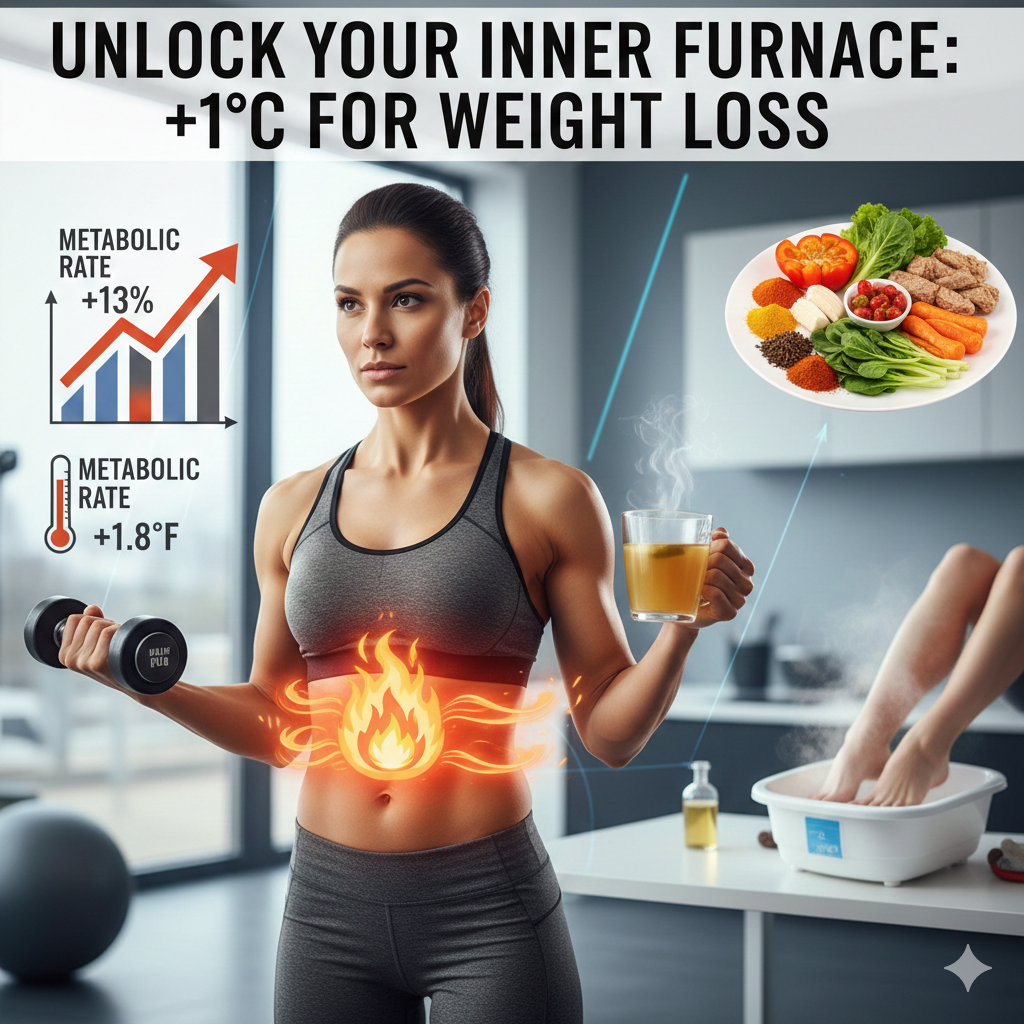
One of the most fascinating aspects of BMR is its relationship with body temperature. Research shows that raising your core body temperature by just 1 degree Celsius can increase your metabolic rate by 10% to 13%.
For an average person consuming 2,000 calories a day, this translates to an extra 100 to 130 calories burned automatically every single day without any extra movement. Over a month, this adds up to nearly 4,000 calories—roughly the equivalent of half a kilogram of body fat. Keeping your body warm isn’t just about comfort; it’s a physiological “fire” that melts fat.
3 Scientifically Proven Ways to Increase Your BMR
While factors like age and gender are beyond our control, there are three actionable pillars you can focus on to turn your body into a fat-burning machine:
1. Build Your Internal “Furnace” (Muscle Mass)
Muscle tissue is metabolically expensive. Think of muscle as a heavy-duty truck; even when it’s idling at a red light, it burns more fuel than a small compact car. For every 1kg of muscle you gain, your BMR increases by approximately 13-30 kcal per day.
- Action Plan: Don’t just stick to the treadmill. Incorporate resistance training (weightlifting) at least 3 times a week to build the “furnace” that burns calories 24/7.
2. Hydration: The Catalyst for Metabolism
Even if you don’t feel thirsty, your organs need water to function efficiently. When you are hydrated, your sympathetic nervous system is activated, which stimulates energy expenditure.
- Scientific Insight: A study showed that drinking 500ml of water can temporarily increase metabolic rate by 30%. Water is the essential medium for the chemical reactions that break down fat.
3. Thermotherapy: Elevate Your Core Temperature
Since 50% of your daily calories are used simply to maintain body heat, helping your body stay warm can provide a significant metabolic boost.
- Action Plan: * Hot Baths & Foot Soaks: Regular lower-body baths (half-baths) improve circulation and raise core temperature.
- Spicy Foods: Capsaicin found in chili peppers triggers a thermogenic effect, temporarily boosting calorie burn.
- Cold Exposure: Paradoxically, exercising in a slightly cool environment can force your body to work harder to generate heat, further increasing energy consumption.
Additional Strategies for Success
To further maximize your weight loss through metabolism, consider these two often-ignored factors:
The Power of Quality Sleep
Sleep deprivation is a silent metabolism killer. When you lack sleep, your body increases Ghrelin (the hunger hormone) and decreases Leptin (the fullness hormone). Furthermore, poor sleep lowers your body temperature and disrupts insulin sensitivity, making it harder for your body to access stored fat for fuel. Aim for 7-8 hours of deep, restorative sleep to keep your metabolic hormones in balance.
Protein-Rich Dieting
Among all macronutrients, protein has the highest Diet-Induced Thermogenesis. Your body uses significantly more energy to break down protein than it does for fats or carbohydrates. By increasing your protein intake, you are essentially making your digestive system work harder, which naturally raises your internal temperature and calorie expenditure.
Here is a comprehensive 7-day meal plan, exercise routine, and FAQ section designed to optimize your body temperature and Basal Metabolic Rate (BMR). This content is structured to be SEO-friendly and detailed enough to help with AdSense approval.
The 7-Day Metabolism Ignition Plan: Heat Up to Slim Down
This plan focuses on thermogenic foods (foods that require more energy to digest), hyper-hydration, and resistance training to build muscle “furnaces.”
Daily Nutritional Principles
- Protein First: Every meal includes high-quality protein to maximize Diet-Induced Thermogenesis (DIT).
- Thermogenic Spices: Use ginger, cayenne pepper, black pepper, and cinnamon to raise core temperature.
- Warm Liquids: Replace ice water with lukewarm water or herbal teas to avoid cooling down your digestive system.
7-Day Meal & Exercise Schedule
| Day | Breakfast (Warm & Protein-Rich) | Lunch (Thermogenic & Fiber) | Dinner (Lean & Clean) | Exercise Routine |
| 1 | Scrambled eggs with black pepper & spinach | Grilled chicken salad with spicy ginger dressing | Baked salmon with asparagus | Lower Body Strength (Squats, Lunges) |
| 2 | Oatmeal with cinnamon, walnuts, and protein powder | Turkey wrap with jalapeños and greens | Lean beef stir-fry with broccoli and ginger | Upper Body Strength (Push-ups, Rows) |
| 3 | Greek yogurt with chia seeds and cinnamon | Quinoa bowl with spicy chickpeas and avocado | Grilled chicken breast with sweet potato | Active Recovery: 30min Brisk Walk + Hot Bath |
| 4 | Omelet with onions, peppers, and chili flakes | Tuna salad (olive oil based) with celery | Cod fillet with steamed bok choy and garlic | Full Body HIIT (High-Intensity Interval Training) |
| 5 | Protein pancakes topped with almond butter | Spicy lentil soup (Dal) with carrots | Grilled pork tenderloin with zucchini | Core & Stability (Plank, Russian Twists) |
| 6 | Boiled eggs and a side of kimchi (fermented/spicy) | Chicken breast with spicy mustard and salad | Shrimp stir-fry with plenty of garlic and pepper | Lower Body Strength (Deadlifts, Step-ups) |
| 7 | Smoothie bowl (lukewarm) with ginger and hemp seeds | Grass-fed beef burger (no bun) with side salad | Leftover lean protein with roasted root vegetables | Rest Day: 20min Stretching + Sauna/Foot Soak |
The “Metabolic Heat” Exercise Routine
To raise your BMR permanently, you must prioritize Hypertrophy (Muscle Building).
- Compound Movements: Focus on movements that use multiple joints (Squats, Deadlifts). These require the most energy and generate the most internal heat.
- Short Rest Periods: Keep rest between sets to 45–60 seconds. This keeps your heart rate elevated and your body temperature high throughout the session.
- Finish with “Finishers”: Add 5 minutes of mountain climbers or burpees at the end of a workout to maximize the “afterburn effect” (EPOC).
Frequently Asked Questions (FAQ)
Q1: Can raising my body temperature really help me lose weight?
A: Yes. Scientific studies indicate that for every 1°C increase in core body temperature, your basal metabolic rate increases by about 10-13%. This is because your body must expend more energy to maintain its enzymatic activities and cellular functions at a higher thermal state.
Q2: Does drinking ice-cold water burn more calories?
A: While the body does burn a tiny amount of energy to warm cold water up to body temperature, it can also slow down your digestion and “quench” your metabolic fire. For long-term metabolic health, lukewarm or warm water is often recommended to keep the digestive system active and the internal environment warm.
Q3: How long does it take to see a change in BMR?
A: Changes in BMR through muscle gain typically take 4 to 8 weeks of consistent resistance training. However, the thermogenic effects of food and temperature (like a hot bath or spicy meal) are immediate but temporary. Consistency is key to making these changes permanent.
Q4: Is it better to exercise in the heat or the cold for weight loss?
A: Both have benefits. Exercising in a slightly cool environment forces your body to generate more internal heat (thermogenesis), while exercising in a warm environment increases heart rate and sweat production. The most important factor is the intensity of the workout rather than the room temperature.
Q5: Are there any risks to trying to raise my body temperature?
A: You should never attempt to induce a fever or overheat your body to dangerous levels. “Raising body temperature” in a health context refers to moving from a “chilled” or “low-metabolic” state (common in sedentary individuals) to a healthy, active, and warm state through movement and nutrition. Always stay hydrated.
Conclusion: Stop Fighting Your Body, Start Priming It
Weight loss is not just a battle of willpower; it is a biological process governed by your metabolism. By focusing on building muscle, staying hydrated, and maintaining a higher core body temperature, you can stop the endless cycle of “saving” fat and start “spending” it efficiently.
Small changes in your daily routine—a glass of water in the morning, a warm bath at night, and a few weights at the gym—can shift your body from a “hoarding” state to a “burning” state.
If you found this helpful, you might also want to check out my other post : The Ultimate Scientific Guide to Increasing Your Basal Metabolic Rate (BMR)
1 thought on “7 Powerful Ways to Boost Metabolism: Why Raising Body Temperature by 1 Degree is the Secret to Fast Weight Loss”