
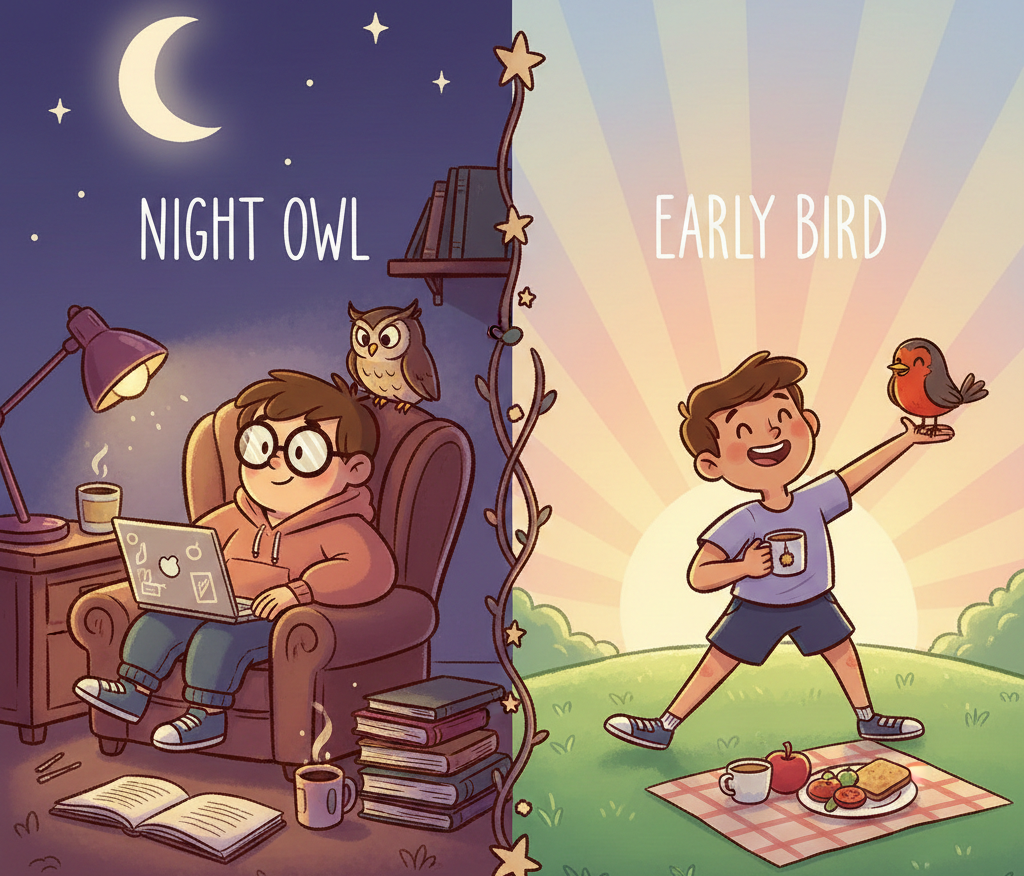
Everyone has a preferred time of day to exercise. Some choose their workout timing based on their jobs, daily tasks, or sleep patterns. For instance, “early birds” who sleep and wake up early tend to enjoy morning workouts, while “night owls” who go to bed late find evening workouts more manageable.
But assuming the duration and intensity of the exercise are the same, does the time of day actually change the results? Let’s dive into the science of circadian rhythms, metabolic rates, and hormonal fluctuations to find the answer.
1. Why Workout Timing Matters for Your Fat Loss Goals
If your primary goal is weight loss and fat reduction, the morning might be your secret weapon. First, let’s look at calorie consumption through the lens of academic research.
A study conducted by a human science team at the University of Tsukuba in Japan analyzed 10 men over the age of 24. They performed 60-minute workouts at 50% of their maximum oxygen intake at three different times: morning (fasted), afternoon (post-meal), and evening (post-meal). The results were staggering. Fasted morning exercise led to a daily energy expenditure of 717 kcal, whereas afternoon and evening workouts only burned 446 kcal and 432 kcal, respectively.
Another study by Northumbria University in the UK compared morning exercise before and after breakfast. As expected, fasted morning exercise burned up to 20% more body fat.
2. Morning Workout Timing: The Secret to Burning 20% More Fat
Beyond just the raw calorie counts, morning exercise—specifically on an empty stomach—works due to several physiological mechanisms:
Metabolic Afterburn: Your body temperature naturally drops during sleep. Morning exercise raises this temperature and “wakes up” your metabolism early, leading to a higher calorie burn that lasts throughout the day—a phenomenon known as EPOC (Excess Post-exercise Oxygen Consumption).
Utilization of Stored Fat: When you wake up, your body is in a fasted state and blood glycogen (stored sugar) levels are depleted. Without immediate glucose from food, your body is forced to draw energy from stored body fat.
Reduced Food Cravings: Researchers at Brigham Young University found that morning exercise actually modulates the brain’s response to food. By tracking neural activity for 24 hours, they observed that women who exercised in the morning showed a significantly decreased desire for high-calorie food pictures.
3. Evening Workout Timing: When Muscle Gain and Performance Peak
While the morning is king for fat loss, evening workouts have their own unique advantages, particularly for those focused on strength and muscle hypertrophy.

Research suggests that core body temperature peaks in the late afternoon (between 4:00 PM and 6:00 PM). During this window, your muscles are more flexible, your reaction time is faster, and your physical strength is generally higher. If you are looking to hit a “Personal Best” in weightlifting, the evening might be better for you.
4. Can a Night Owl Become an Early Bird?
If you are a natural night owl, you might feel that morning exercise is an impossible dream. However, chronobiologists suggest that you can “reset” your internal biological clock. The key is High Light Intensity.
Melatonin, the sleep hormone, is regulated by light entering the retina. By exposing yourself to bright light immediately upon waking—a “sunlight shower”—you signal to your pineal gland that the day has begun.+1
Strategies to Shift Your Chronotype:
- The 15-Minute Rule: Don’t try to wake up two hours earlier overnight. Shift your bedtime and wake-up time by just 15 minutes every two days.
- Strategic Napping: If you feel the “afternoon slump,” take a 10-20 minute power nap. Avoid napping longer than 30 minutes, as you may enter deep sleep and wake up with “sleep inertia” (grogginess).
- Consistency is Key: Your body thrives on rhythm. Keep your wake-up times consistent even on weekends to avoid “social jetlag.”
5. The “Early Bird” Fat-Burning Workout Routine
If you’ve decided to try morning exercise to maximize fat loss, you don’t need a gym membership or hours of time. High-Intensity Interval Training (HIIT) is the most effective way to stimulate the “afterburn effect” in a fasted state.

The 20-Minute Fasted Circuit (No Equipment Needed): Perform each move for 40 seconds, followed by 20 seconds of rest. Repeat the circuit 3 times.
- Jumping Jacks: To elevate the heart rate and wake up the nervous system.
- Bodyweight Squats: Target the largest muscle groups (glutes and quads) to burn maximum glycogen.
- Mountain Climbers: Great for core stability and sustained cardio intensity.
- Alternating Lunges: Improves balance and tones the lower body.
- Plank to Push-up: Builds upper body strength and stabilizes the core.
💡Pro-Tip: If you feel lightheaded during this fasted session, stop immediately and drink some water with a pinch of sea salt or a small slice of fruit.
6. The Post-Workout Nutrition Guide
What you eat after your workout is just as important as the timing of the exercise itself. Proper nutrition ensures muscle recovery and prevents the metabolic slowdown that can happen with fasted training.
For Morning Exercisers (Refuel & Recover)
Since your glycogen stores are low after a fasted morning workout, you need a balance of fast-acting protein and complex carbohydrates.
- The “Recovery Bowl”: 1 cup of Greek yogurt, a handful of blueberries (antioxidants), and 2 tablespoons of granola.
- The “Muscle Builder”: 2 scrambled eggs with spinach served on a single slice of whole-grain toast.
For Evening Exercisers (Repair & Rest)
If you workout in the evening, your goal is muscle repair without a massive insulin spike that might interfere with sleep.
- The “Lean & Green”: Grilled chicken breast or salmon with a large side of steamed broccoli and half an avocado.
- The “Light Refuel”: A protein shake made with almond milk and a small handful of walnuts.
⚡Summary Table: Morning vs. Evening
| Feature | Morning (Fasted) | Evening (Post-Meal) |
| Primary Goal | Fat Loss & Metabolism | Muscle Gain & Performance |
| Hormonal State | High Cortisol, Low Insulin | Peak Body Temperature |
| Fat Burning | ~20% Higher | Standard |
| Risk Factor | Potential Hypoglycemia | May Affect Sleep Quality |
| Best For | Weight Loss Seekers | Athletes & Bodybuilders |
🩺Important Safety Considerations
While fasted morning exercise is powerful, it is not for everyone.
A Note of Caution: Individuals with diabetes or chronic low blood pressure should be extremely careful. Exercising on an empty stomach can trigger hypoglycemia (dangerously low blood sugar). It is always wise to have a small snack, such as a banana or a glucose gel, ready in case you feel dizzy or shaky.
7. Consistency Over Timing
While the science leans heavily toward fasted morning exercise for those battling body fat, the “Golden Rule” of fitness remains: Consistency is King. If a morning routine causes you so much stress that you quit after three days, it is better to exercise in the evening and stay consistent for years. Use the “Sunlight Shower” and the 15-minute transition plan to slowly move toward a morning schedule, but listen to your body’s signals above all else.
🙋FAQ
Q1. Does workout timing really affect weight loss results?
Yes, research shows that workout timing plays a significant role in fat metabolism. Exercising in the morning in a fasted state can burn up to 20% more body fat compared to afternoon or evening sessions, as the body utilizes stored fat for energy when glycogen levels are low.
Q2. Is it safe to exercise on an empty stomach in the morning?
For most healthy individuals, fasted morning exercise is safe. However, if you have conditions like diabetes or low blood pressure, it could lead to hypoglycemia (dizziness or shakiness). Always listen to your body and keep a small snack or electrolyte drink nearby if you feel lightheaded.
Q3. Can evening workout timing be effective for muscle growth?
Absolutely. While morning is king for fat loss, evening workout timing is often better for strength and hypertrophy. Body temperature peaks in the late afternoon, leading to increased muscle flexibility, faster reaction times, and higher physical performance.
Q4. How can I change my workout timing from evening to morning?
You can reset your internal clock by using the “15-Minute Rule”—gradually shifting your wake-up time 15 minutes earlier every two days. Additionally, exposing yourself to bright sunlight immediately upon waking helps suppress melatonin and signals your body to stay alert.
📖Glossary
- Circadian Rhythm: The 24-hour internal clock that cycles between sleepiness and alertness.
- Melatonin: A hormone that regulates the sleep-wake cycle; often suppressed by bright light.
- Cortisol: Often called the “stress hormone,” it peaks in the morning to help wake the body up.
- EPOC: Excess Post-exercise Oxygen Consumption, often called the “afterburn effect,” where the body continues to burn calories after a workout.
- Chronotype: An individual’s natural inclination regarding the periods of time when they sleep or are most active.Fasted State: A period (usually 8-12 hours) where the body has finished digesting food and insulin levels are low.
- Glycogen: The primary fuel source for high-intensity exercise, stored in the muscles and liver.
- HIIT (High-Intensity Interval Training): A workout involving short bursts of intense exercise alternated with low-intensity recovery periods.
- Hypoglycemia: A condition where blood sugar levels drop below the healthy range, often causing dizziness.
- Metabolism: The chemical processes that occur within a living organism in order to maintain life and burn energy.
Conclusion: Finding Your Personal Window
Ultimately, the “best” time to exercise is the time you can stick to consistently. However, if you are stuck in a weight-loss plateau, switching to a fasted morning routine might be the metabolic spark you need. By aligning your physical activity with your body’s natural hormonal cycles, you can achieve better results in less time.
If you found this helpful, you might also want to check out my guide on The 5-Minute Morning Mobility Secret: Wake Up Your Body and Brain
1 thought on “The Best Workout Timing: 7 Reasons to Exercise Early for 20% More Fat Loss”