Is stretching helpful for escaping obesity? While it may not burn as much fat as intense exercise, the answer is a definite “Yes.”
When we think of weight loss, we typically visualize sweat-drenched HIIT sessions, long-distance running, or heavy weightlifting. Stretching is often relegated to a quick five-minute afterthought at the end of a workout. However, emerging physiological research suggests that stretching—the deliberate lengthening of muscles—is a foundational pillar for metabolic health and fat loss.
If you are struggling to break through a weight-loss plateau or find intense exercise too taxing on your joints, understanding the science of stretching might be the missing piece of your fitness puzzle.
Table of Contents
1. The Power of “Pandiculation”: Waking Up the Metabolic Engine
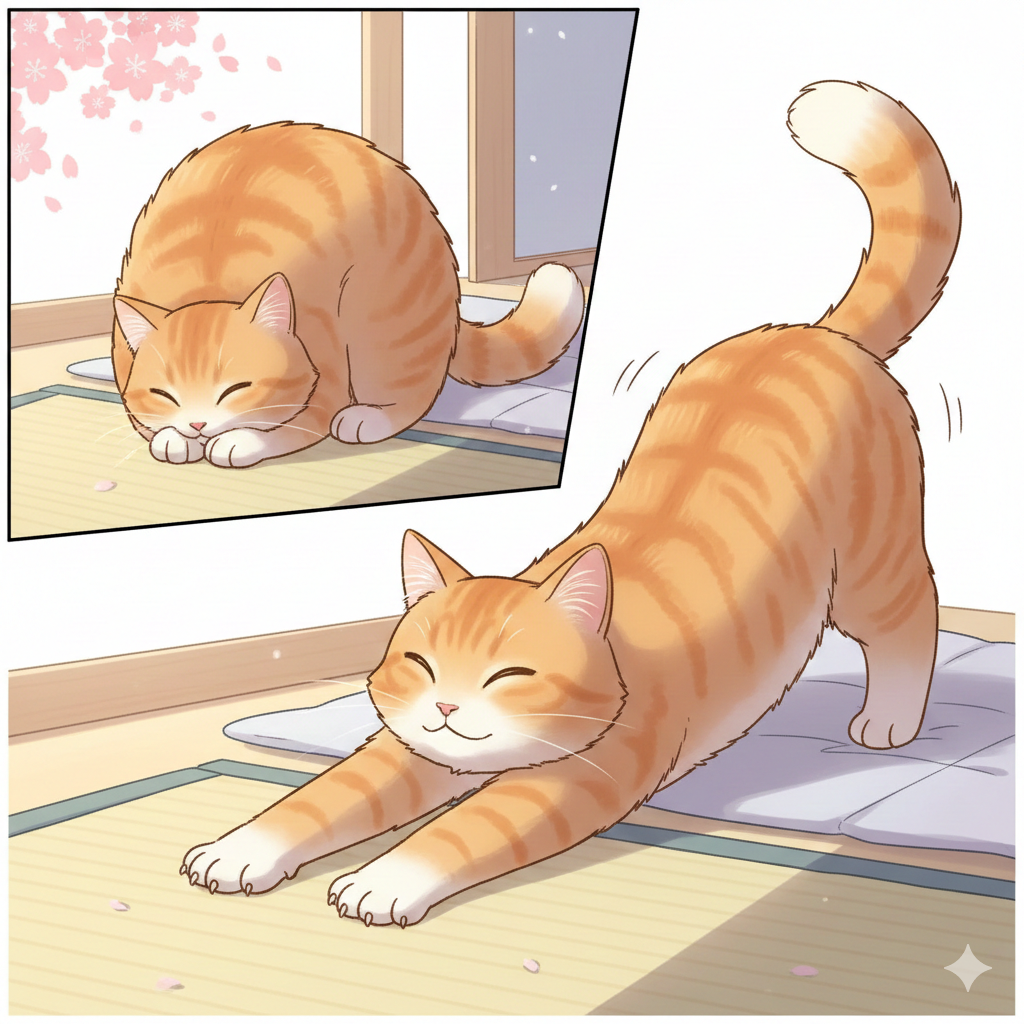
Have you ever noticed how a dog or cat stretches immediately after waking up? Humans have a similar instinctual reflex called pandiculation. Instinctive act of stretching when you wake up or when your body feels stiff. By stretching the body to its limit, you wake up your muscles—that is pandiculation. It is the act of stretching the body to its limit, often accompanied by a yawn, to “reset” the nervous system.
Transitioning to “Activity Mode”
Our bodies are designed to stay tense as a survival mechanism, keeping muscles ready for emergencies. Over time, this chronic tension causes soft tissues—muscles, fascia, ligaments, and tendons—to contract and shorten. When your tissues are “locked,” your mobility decreases, and your blood circulation becomes sluggish.
Pandiculation and intentional stretching break this cycle. By expanding your range of motion, you signal to your brain that the body is moving from a sedentary state into “activity mode.” This increases oxygen supply to the cells, effectively priming your “internal furnace” to start burning fuel.
2. Four Scientific Ways Stretching Accelerates Weight Loss
While stretching isn’t a high-intensity calorie burner like sprinting, its cumulative effect on the body’s weight-loss mechanisms is profound.
A. Direct Caloric Expenditure
It is a misconception that stretching burns zero calories. While you aren’t sprinting, you are still engaging muscle fibers.
- The Math: A person weighing approximately 68 kg (150 lbs) burns about 85 kcal during 30 minutes of active stretching.
- The Comparison: Compare this to sitting on a couch, which burns only about 34 kcal in the same timeframe. By choosing to stretch for 30 minutes every evening while watching TV, you burn an extra 18,000+ calories per year—enough to lose over 2.5 kg of pure fat without changing anything else.
B. Improving “Fuel Efficiency” through Vascular Health
Stretching doesn’t just move muscles; it moves blood. Research from the University of Florida College of Medicine has shown that daily stretching improves vascular endothelial function.3
In a landmark study, participants who stretched 5 days a week for 4 weeks showed a significant increase in microvascular volume. Essentially, stretching helps your body grow new, tiny blood vessels. More blood vessels mean more oxygen and nutrients can reach your muscles, making them more efficient at burning glucose and fat during both rest and exercise.
C. The Arterial Connection
A 2020 study published in The Journal of Physiology confirmed that lower-body stretching (5 times a week for 12 weeks) improved arterial blood flow and significantly reduced arterial stiffness.4 This is critical for obesity prevention because stiff arteries are often linked to metabolic syndrome and high blood pressure.
D. Appetite Control via the Nervous System
Obesity is often linked to “stress eating.” When we are stressed, our sympathetic nervous system (fight or flight) is overactive, leading to high levels of cortisol, which triggers cravings for sugar and fat.5
Researchers at Keio University in Japan found that just five 1-minute stretches can activate the parasympathetic nervous system (rest and digest). This releases endorphins, stabilizes the heart rate, and lowers cortisol, helping to suppress the emotional urge to overeat.
3. The Structural Benefit: Preventing the “Injury Plateau”
One of the biggest obstacles to weight loss is injury. When an obese or sedentary individual starts an intense exercise program, their stiff joints and short tendons are at high risk.
- The 4% Rule: Muscle fibers are incredibly elastic and can stretch up to 1.5 times their length. However, tendons (which connect muscle to bone) are far less forgiving. If a tendon is stretched only 4% beyond its limit, it can tear.
- Stability through Mobility: Stretching ensures that your joints can move through their full range.6 This prevents the compensatory pains—like lower back pain or knee strain—that often cause people to quit their weight-loss journeys prematurely.
4. Static vs. Dynamic Stretching: Which is Best for Fat Loss?
To maximize weight loss, you must use the right type of stretch at the right time.
Dynamic Stretching (The Warm-Up)
Definition: Controlled, functional movements that mimic the exercise you are about to do (e.g., leg swings, arm circles, lunges).
- When: Before exercise.
- Why: It increases core temperature and “greases” the joints. It prepares the soft tissues for the workload, ensuring you can perform at a higher intensity (burning more calories) during your workout.7
Static Stretching (The Recovery)
Definition: Holding a single position to lengthen the muscle (e.g., touching your toes, quad stretch).
- When: After exercise or before bed.
- Why: This is when your body temperature is high, making the fascia more pliable.8 Static stretching after a workout helps flush out metabolic waste and speeds up tissue recovery, meaning you won’t be too sore to exercise again the next day.9+1
5. A Practical 15-Minute Daily Stretching Routine for Beginners
If you want to use stretching as a weight-loss tool, consistency is key. Try this routine daily:
| Exercise | Duration | Target Area | Benefit |
| Cat-Cow Pose | 2 Minutes | Spine & Core | Improves posture and digestion. |
| Deep Lunges | 3 Minutes | Hip Flexors | Reverses the damage of sitting all day. |
| Downward Dog | 3 Minutes | Hamstrings & Calves | Increases lower body blood flow. |
| Pigeon Pose | 4 Minutes | Glutes & Hips | Releases deep emotional stress/tension. |
| Child’s Pose | 3 Minutes | Full Body | Activates the parasympathetic system. |
6. Important Precautions for Safe Practice
To avoid injury and ensure your stretching contributes to health rather than harm, keep these “Golden Rules” in mind:
- The 30-Second Rule: For static stretches, you must hold the position for at least 30 seconds.10 It takes this long for the “fascia”—the connective tissue wrapping your muscles—to actually begin to lengthen.
- Breathe into the Stretch: Never hold your breath. Deep, diaphragmatic breathing assists in the delivery of oxygen to the muscles you are stretching.11
- Respect the Pain Barrier: Stretching should feel like “productive discomfort,” never sharp pain. If you feel a pinching or stabbing sensation, stop immediately.
- Warm Muscles First: Never aggressively stretch “cold” muscles (like jumping straight into a split after waking up). Do some light movement or a warm shower first to increase blood flow.
Conclusion: Stretching is the Foundation of a Lean Body
While stretching won’t replace the need for a healthy diet or cardiovascular exercise, it acts as the catalyst that makes those efforts more effective. By improving your vascular health, lowering your stress hormones, and increasing your caloric burn, stretching transforms your body into a more efficient, fat-burning machine.
Don’t think of stretching as a chore; think of it as a way to “unlock” your body’s full potential. Start with just 10 minutes tonight, and you may find that the path to weight loss becomes much smoother.
Glossary
- Adductors: The group of muscles located on the inner thigh responsible for pulling the legs toward the center of the body.
- Ballistic Stretching: A risky technique using bouncing or jerking movements to force a joint beyond its range; it can trigger the stretch reflex and cause injury.
- Compound Movement: An exercise that engages multiple joints and muscle groups simultaneously, such as a squat or a lunge.
- Dynamic Stretching: Active movements that take joints and muscles through a full range of motion to “prime” the body for physical activity.
- Hamstrings: The large muscle group at the back of the thigh, essential for knee flexion and hip extension.
- Hip Flexors: The muscles at the front of the hip used to lift the knee toward the torso; often tight in people who sit for long periods.
- Neuromuscular System: The complex network connecting the brain (nerves) and muscles; dynamic stretching improves this communication for better coordination.
- Obliques: The abdominal muscles on the sides of the torso that facilitate rotation and lateral bending.
- Posterior Chain: The entire series of muscles on the backside of the body, including the lower back, glutes, hamstrings, and calves.
- Range of Motion (ROM): The full distance a joint can move comfortably and safely in various directions.
- Rotator Cuffs: A group of four muscles and tendons that stabilize the shoulder joint, which is highly mobile but prone to injury.
- Sitting Disease: A term for the health risks and muscular stiffness associated with a sedentary lifestyle and prolonged sitting.
- Static Stretching: A method of stretching where a position is held for a set duration (30–60 seconds) while the muscle is at rest.
- Stretch Reflex: An automatic muscle contraction triggered by a sudden, rapid stretch; it acts as a safety mechanism to prevent muscle tearing.
- Synovial Fluid: The natural lubricant within joint cavities; movement increases its secretion to reduce friction during exercise.
- Thoracic Spine: The middle segment of the spine (upper/mid-back) that requires high mobility for healthy rotation and posture.
- Traps (Trapezius): Large muscles extending from the base of the skull to the middle of the back, often where stress-related tension is held.
If you found this helpful, you might also want to check out my other post : Dynamic Stretching: 12 Expert Tips and Techniques for Beginners
2 thoughts on “7 Scientific Secrets: How Stretching Unlocks Your Body’s Natural Fat-Burning Power”