
Do you wake up feeling like a rusted gate? For many of us, the first few minutes of the day involve hitting the snooze button and dragging ourselves to the coffee maker with stiff joints and a foggy mind. But what if you could transform your energy levels, mental clarity, and physical flexibility in just 300 seconds?
Welcome to the world of Morning Mobility. This guide provides three distinct 5-minute routines tailored to your specific needs—whether you are a busy professional, a fitness enthusiast, or someone dealing with chronic stiffness.
Why 5 Minutes? The Science of Morning Mobility
When you sleep, your body enters a state of repair. However, lack of movement causes your “fascia” (the connective tissue surrounding your muscles) to become slightly dehydrated and sticky. This is why you feel “stiff” in the morning.
By engaging in a purposeful 5-minute stretch, you achieve three critical biological goals:
- Increased Blood Flow: You move oxygenated blood to your brain and extremities.
- Synovial Fluid Activation: You lubricate your joints, reducing the “grinding” sensation in knees and shoulders.
- Cortisol Regulation: Gentle movement helps transition your body from sleep mode to alert mode without the “spike” of high-intensity stress.
If you often wake up feeling stiff or sluggish, this quick routine is for you. Here are some step-by-step guides to a 5-minute morning stretch that you can do right next to your bed!
Option 1: The “Desk Warrior” Routine (Focus on Posture)
Best for: People who spend 8+ hours sitting at a computer.
This routine targets the “tech neck” and tight hips caused by sedentary lifestyles.
- Standing Tall Cat-Cow (60 Seconds): Stand with hands on your thighs. Inhale, arch your back, and look up. Exhale, round your spine, and tuck your chin. Why: It wakes up the spinal discs and releases tension in the upper back.
- Doorway Chest Stretch (60 Seconds): Place your forearms on a door frame and lean forward slightly. Why: It opens the pectoral muscles that collapse forward while typing.
- Wall Slides (60 Seconds): Stand against a wall, arms in a “W” shape, and slide them up into a “Y.” Why: This activates the mid-back muscles responsible for good posture.
- Standing Quad Stretch (60 Seconds): Hold one foot behind you, keeping knees together. Switch at 30 seconds. Why: Sitting shortens the quads and hip flexors; this resets them.
- Neck Half-Moons (60 Seconds): Slowly roll your chin from one shoulder to the other. Why: Releases tension in the trapezius muscles.
Option 2: The “Full Body Flow” (Focus on Energy)
Best for: A general metabolic boost and total body awakening.
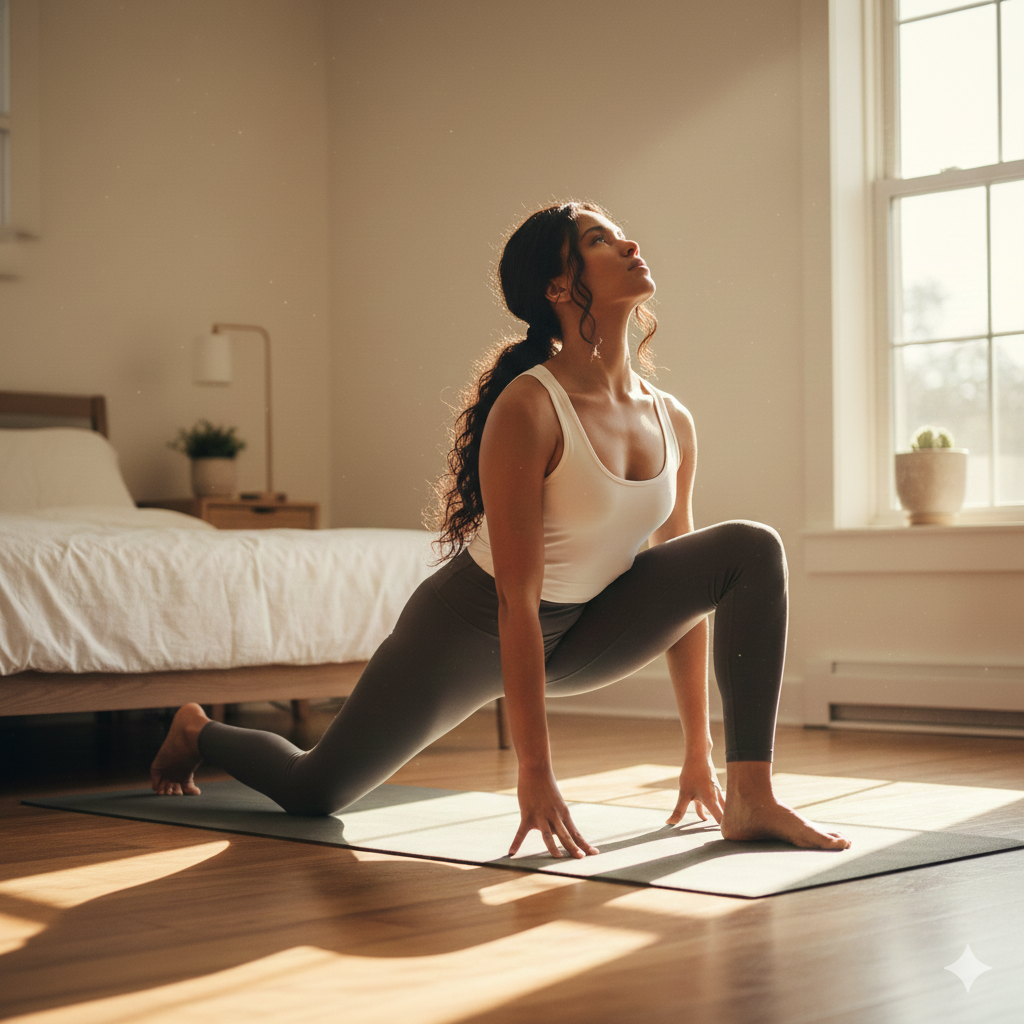
- The “World’s Greatest Stretch” (90 Seconds): Step forward into a deep lunge, place the opposite hand on the floor, and reach your other hand toward the sky. Switch sides. Why: It hits the hips, hamstrings, and thoracic spine all at once.
- Lateral Side Reaches (60 Seconds): Reach one arm over your head and lean to the side. Switch. Why: It opens the intercostal muscles (between ribs), allowing for deeper breathing.
- Bodyweight Deep Squat Hold (60 Seconds): Drop into a deep squat, pushing your knees out with your elbows. Wiggle side to side. Why: It opens the ankles, knees, and hips simultaneously.
- Arm Circles & Shrugs (90 Seconds): Large circles forward and back, ending with forceful shoulder shrugs to release the “weight of the world.”
Option 3: The “In-Bed” Routine (For Extreme Stiffness)
Best for: Those who struggle to get out of bed due to back pain or low energy.
- Knee-to-Chest Hugs (60 Seconds): Lying on your back, pull one knee to your chest, then the other, then both. Why: Gently stretches the lower back (lumbar spine).
- Supine Spinal Twist (60 Seconds): Drop both knees to the left while looking to the right. Switch. Why: Realigns the vertebrae after hours of lying still.
- Happy Baby Pose (60 Seconds): Grab the outsides of your feet and pull your knees toward your armpits. Why: Deeply opens the pelvic floor and lower hips.
- Ankle & Wrist Rotations (60 Seconds): Circle both 10 times in each direction. Why: Wakes up the peripheral nervous system.
- Seated Overhead Reach (60 Seconds): Sit at the edge of the bed, interlace fingers, and push your palms toward the ceiling.
Option 4: The “Lower Back Relief” Routine
Best for: People who wake up with a dull ache in the lumbar spine or stiffness in the glutes.
Many people mistake back pain for a back problem, when it is actually a hip and hamstring problem. This routine decompresses the spine by loosening the muscles that pull on it.
- The Pelvic Tilt (60 Seconds): Lying on your back with knees bent, flatten your lower back against the floor by tightening your abs, then arch it slightly. Why: It gently “re-hydrates” the spinal discs and engages the deep core.
- Figure-Four Stretch (60 Seconds): While lying down, cross your right ankle over your left knee. Gently pull your left thigh toward you. Switch at 30 seconds. Why: Targets the piriformis and glutes, which, when tight, are the leading cause of sciatica-like back pain.
- 90/90 Hip Switches (60 Seconds): Sit on the floor with both knees bent at 90-degree angles (one in front, one to the side). Slowly rotate your knees to the opposite side without lifting your feet. Why: Improves internal and external hip rotation, taking the “load” off the lower back.
- Child’s Pose with Side Reach (60 Seconds): From a kneeling position, sit back on your heels and reach forward. Then, walk your hands to the left, then the right. Why: Stretches the latissimus dorsi and the QL (Quadratus Lumborum) muscles in the lower back.
- Bird-Dog (60 Seconds): On all fours, extend your opposite arm and leg simultaneously. Hold for 2 seconds and switch. Why: This is a “stability stretch” that wakes up the multifidus muscles which support the spine.
Option 5: The “Yoga-Inspired Flow” (Sun Salutation Variant)
Best for: Improving flexibility and mindfulness simultaneously.
This routine focuses on Vinyasa (breath-synchronized movement) to improve circulation and lung capacity.
- Mountain Pose to Forward Fold (60 Seconds): Inhale, reach for the ceiling; exhale, fold down to touch your toes. Keep knees slightly bent. Why: It cycles blood flow to the brain and stretches the entire posterior chain.
- Plank to Downward Facing Dog (60 Seconds): From a push-up position, push your hips back and up into a “V” shape. Peddle your feet (calf pumps). Why: This is the ultimate “full-body” reset, stretching the calves, hamstrings, and shoulders.
- Cobra Pose (60 Seconds): Lie on your stomach and gently push your chest up while keeping your hips on the floor. Why: Counteracts the “slumped” posture of modern life by stretching the abdominal wall and chest.
- Low Lunge with Heart Opener (60 Seconds): Step one foot forward into a lunge, drop the back knee, and reach your arms back. Switch at 30 seconds. Why: Stretches the hip flexors and opens the heart center for better breathing.
- Standing Side Stretch (60 Seconds): Stand tall, grab your left wrist with your right hand, and pull toward the right. Switch. Why: Stretches the obliques and helps expand the ribcage.
Option 6: The “High-Energy Athlete” Routine
Best for: People who plan to workout shortly after waking up.
This routine uses Dynamic Plyometric Stretching to prime the central nervous system (CNS).
- Leg Swings: Front-to-Back (60 Seconds): Hold a wall and swing your leg like a pendulum. 30 seconds per leg. Why: Dynamically prepares the hamstrings for explosive movement.
- High Knee March with a Twist (60 Seconds): March in place, bringing your knee high and rotating your opposite elbow toward it. Why: Activates the hip flexors and obliques simultaneously.
- Butt Kicks in Place (60 Seconds): Jog lightly in place, kicking your heels toward your glutes. Why: A dynamic stretch for the quadriceps that increases heart rate.
- T-Spine Windmills (60 Seconds): Stand with feet wide, lean forward, and touch your right hand to your left foot while the left hand reaches for the sky. Switch rapidly but controlled. Why: Essential for rotational power in sports like golf, tennis, or weightlifting.
- Seal Jumps (60 Seconds): Like jumping jacks, but clap your hands in front of your chest rather than over your head. Why: Opens the chest while waking up the calves and ankles.
How to Stay Consistent: The “Habit Stacking” Method
To get AdSense-level engagement, you need to provide lifestyle advice. The biggest barrier to stretching is forgetting to do it. Use Habit Stacking:
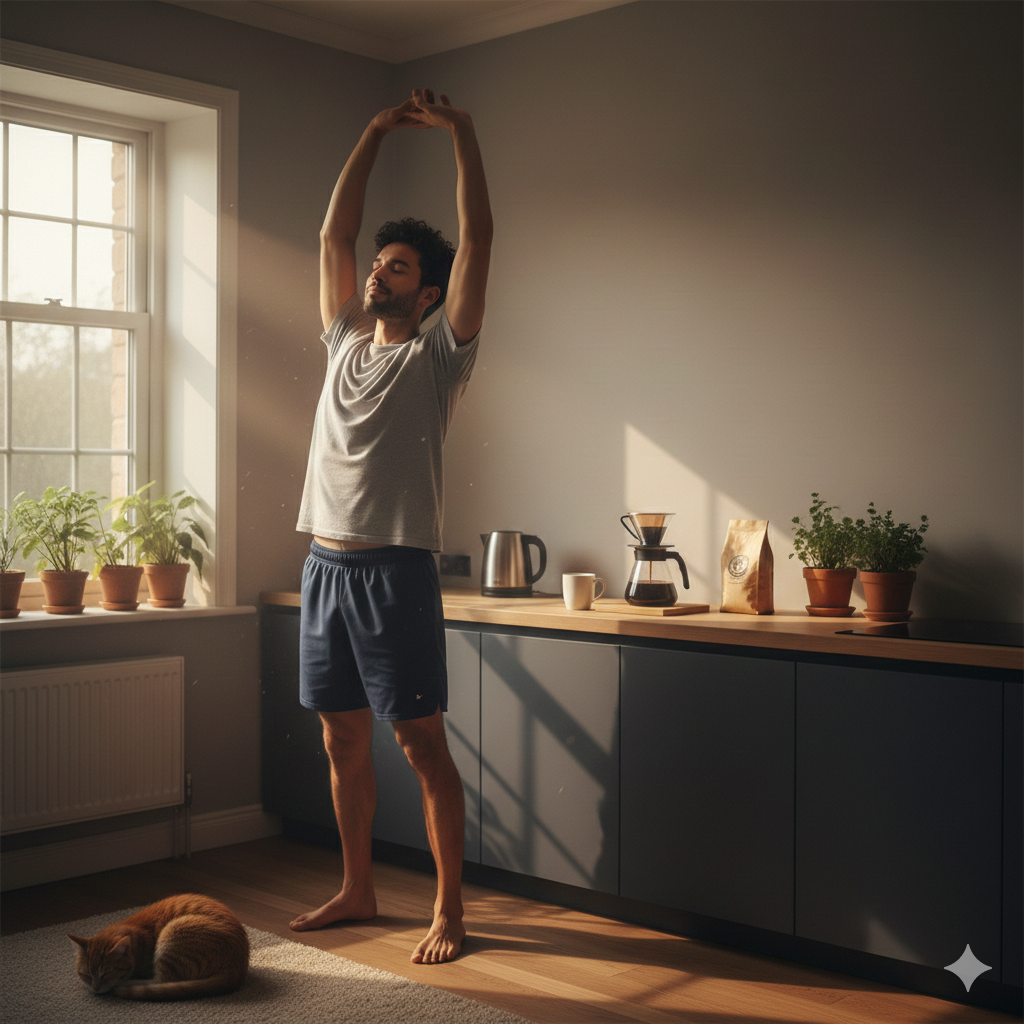
- Stretch while your coffee is brewing.
- Stretch while you wait for the shower to get warm.
- Stretch immediately after checking your first morning alarm.
Glossary of Mobility Terms
- Anterior Pelvic Tilt: A common postural misalignment where the front of the pelvis rotates forward, often caused by tight hip flexors.
- Dynamic Stretching: Stretching through movement, rather than holding a pose. Ideal for mornings.
- Fascia: A thin casing of connective tissue that surrounds and holds every organ, blood vessel, bone, nerve fiber, and muscle in place.
- Intercostal Muscles: Muscles between the ribs that assist in lung expansion. Stretching these improves oxygen intake.
- Lumbar Spine: The lower back area consisting of five vertebrae (L1–L5).
- Proprioception: The body’s ability to sense its location, movements, and actions. Morning stretching “re-calibrates” this sense.
- Thoracic Mobility: The ability of the middle and upper back to move and rotate freely.
Frequently Asked Questions (FAQ)
1. Should I stretch before or after breakfast?
Stretching is best done before breakfast. It acts as a signal to your digestive system to wake up and can help regulate blood sugar levels before your first meal.
2. Is it normal to feel “clicks” and “pops”?
Yes, as long as there is no pain. These are often air bubbles (gas) being released from the joint capsule or tendons snapping back into place as they move over bone.
3. Can I stretch if I have a back injury?
If you have a diagnosed injury (like a herniated disc), avoid deep twisting or forward folds. Stick to the “In-Bed” routine and consult a physical therapist first.
4. What if I only have 2 minutes?
Do the “World’s Greatest Stretch” for 60 seconds on each side. It is the most efficient single movement for the entire body.
Conclusion: Investment in Your Future Self
Morning stretching isn’t about becoming a gymnast; it’s about functional longevity. By spending just 5 minutes today, you are preventing the chronic pain of tomorrow. You are telling your body that it is ready to handle the day’s stress, and you are telling your brain that you are in control.
Start tomorrow morning. Don’t look at your phone. Don’t check your email. Just move. Your body will thank you by 2:00 PM when everyone else is hitting the “afternoon slump” and you are still feeling agile and alert.
How do you feel after trying this? Let me know in the comments below!
If you found this helpful, you might also want to check out my guide on Does Stretching Help with Weight Loss?
2 thoughts on “The 5-Minute Morning Mobility Secret: Successfully Wake Up Your Body and Brain”