
The journey to a healthier, leaner physique is rarely a straight line. Most people eventually hit the “Dreaded Plateau.”
This is a frustrating phase where numbers on the scale refuse to move. Even with meticulous calorie counting and grueling gym sessions, progress stops.
While your instinct may be to eat less or exercise more, this often backfires. Instead, the secret weapon to reigniting your metabolism might be the “Cheat Day.”
A successful cheat day is not about mindless bingeing. It is a calculated physiological tool known as a Refeed. This guide explores how to master the cheat day to achieve sustainable fat loss.
The Science of the Plateau: Why Progress Stops
To understand cheat days, we must first understand why weight loss stops. Human biology is governed by Homeostasis. This is the body’s desire to maintain a stable internal environment.
When you stay in a caloric deficit too long, your body perceives a survival threat. It doesn’t know you want to look good; it thinks you are starving.
To conserve energy, your body initiates Adaptive Thermogenesis. This causes several changes:
- Metabolic Slowdown: Your Basal Metabolic Rate (BMR) drops. You burn fewer calories for the same tasks.
- Hormonal Shift: Leptin (fullness) plummets, and Ghrelin (hunger) spikes.
- Thyroid Changes: Your T3 and T4 hormones decrease, slowing your metabolism.
- Reduced NEAT: You subconsciously move less and feel lethargic.
A strategic cheat day acts as a “metabolic reset.” It signals to the brain that the famine is over. This can temporarily reverse these negative adaptations. the famine is over, temporarily reversing these negative adaptations.
Cheat Day vs. Refeed Day: Know the Difference
In the fitness community, these terms are often used interchangeably, but their applications differ:
The “Dirty” Cheat Day
This is the stereotypical “Epic Cheat Day” seen on YouTube. It involves eating anything and everything—pizza, donuts, fried chicken, and ice cream—without regard for total calories. While psychologically satisfying for some, the massive influx of fats and sugars can lead to significant fat regain and digestive distress.
The “Clean” Refeed Day
A refeed is a planned increase in calories, focusing specifically on Carbohydrates.
Because carbs drive leptin production and muscle glycogen replenishment, a clean refeed provides metabolic benefits with minimal risk of body fat storage.
Step-by-Step Strategy to Implement a Cheat Day
To ensure your cheat day helps rather than hinders your progress, follow these structural guidelines:
A. Calculate Your Ceiling
A cheat day shouldn’t be bottomless. Aim for Maintenance Calories or a slight surplus (roughly 10% to 20% above your maintenance level). If you usually eat 1,800 calories to lose weight and your maintenance is 2,300, aim for 2,500–2,700 calories on your cheat day.
B. Prioritize Macronutrients
- High Carbohydrates: This is the priority. Pasta, rice, potatoes, and fruit help “refill” your muscles and signal the brain to boost metabolism.
- Moderate Protein: Keep protein intake steady to support muscle maintenance.
- Low Fat: Since you are consuming high calories and carbs, keeping fats low (below 50g) minimizes the chance of those calories being stored as adipose tissue.
C. Timing is Everything
If you have a high body fat percentage, your body has plenty of “stored energy,” and you likely don’t need a cheat day more than once every 3–4 weeks. If you are already lean (under 15% for men, 22% for women), a weekly refeed might be necessary to prevent muscle loss and hormonal crashes.
Psychological Benefits: The “Sanity” Factor
Dieting is as much a mental challenge as a physical one. Constant restriction leads to “decision fatigue.” A planned cheat day provides:
- A Goal Post: It’s easier to stay strict from Monday to Saturday if you know Sunday is a “free” day.
- Social Flexibility: It allows you to attend birthdays or dinners without the stress of bringing a Tupperware of broccoli.
- Reduced Cravings: Satisfying a craving in a controlled manner prevents a future uncontrolled binge.
The Ultimate Cheat Day Food List: What to Eat for Maximum Results
Not all “cheat” foods are created equal. If your goal is to break a plateau, you want foods that are high in carbohydrates (to spike leptin) but relatively low in fats (to prevent easy fat storage).
Here is a curated list of the best foods to include on your strategic cheat day, categorized by their benefits.
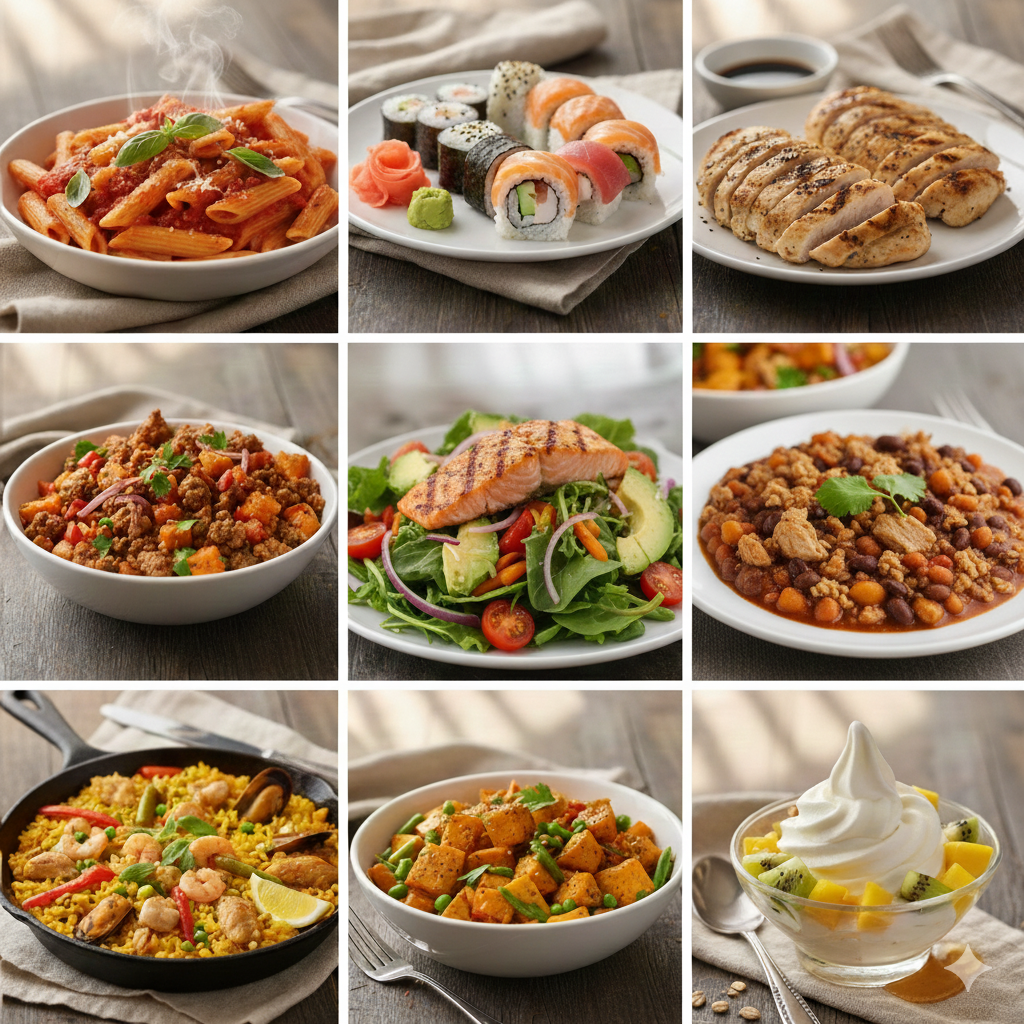
1. The “Glycogen Refillers” (Complex Carbohydrates)
These are the gold standard for a refeed day. They provide sustained energy and fill up your muscle tissue, making you look fuller and more “pumped.”
- Sweet Potatoes & White Potatoes: These are clean sources of starch. Try oven-baked fries or mashed potatoes with minimal butter.
- Pasta: A large bowl of pasta with a tomato-based (Marinara) sauce is a perfect low-fat, high-carb choice.

- Sushi: Specifically rolls with white rice, fish, and vegetables. Avoid the “crunchy” or mayo-heavy rolls to keep the fat low.
- Oatmeal & Cream of Rice: Add honey, maple syrup, and fruits for a massive glycogen boost.
2. The “Leptin Spikers” (Sweet but Functional)
While you should avoid a total sugar binge, certain sweets can help signal the brain that energy is abundant.

- Pancakes or Waffles: Top them with fruit and syrup rather than heavy whipped cream or butter.
- Frozen Yogurt: A better alternative to ice cream because it is typically lower in fat but still provides the glucose needed for a metabolic spike.
- Angel Food Cake: This is almost entirely carbohydrates and protein with zero fat, making it the “safest” dessert for a refeed.
- Cereal: High-carb, low-fat cereals (like Corn Flakes or Rice Krispies) with skim milk are a favorite among bodybuilders during refeeds.
3. The “Muscle Builders” (High Protein Indulgences)
You still need protein to protect your muscle mass while your metabolism speeds up.

- Lean Grilled Burgers: Use a lean beef patty or turkey patty and enjoy it with a bun (extra carbs!).
- Grilled Chicken Pizza: Opt for a thin crust and load it with chicken and vegetables instead of extra cheese and pepperoni.
- Seafood Paella: Combines high-quality protein from shellfish with a massive amount of rice.
Foods to Limit (Even on a Cheat Day)
To ensure your cheat day doesn’t turn into a “fat gain day,” try to limit foods that are high-fat and low-carb simultaneously. These foods do very little to boost leptin but are very easy for the body to store as fat.
- Deep-Fried Foods: Donuts, fried chicken, and mozzarella sticks are loaded with trans fats that cause inflammation.
- Heavy Cream Sauces: Alfredo sauce or heavy gravies add massive calories without the metabolic benefits of carbohydrates.
- High-Fat Meats: Bacon, sausage, and fatty ribeye steaks are better suited for a Keto diet than a strategic refeed day.
Sample “Metabolic Reset” Cheat Day Menu
To give you an idea of how to structure your day, here is a 2,500–2,800 calorie example:
- Breakfast: 3 Large Pancakes with maple syrup and a side of egg whites.
- Lunch: A large bowl of Pasta Marinara with grilled chicken breast and a side of sourdough bread.
- Snack: A bowl of fruit salad or low-fat granola with honey.
- Dinner: 10-12 pieces of Sushi (Nigiri and basic rolls) with soy sauce and ginger.
- Dessert: A serving of Frozen Yogurt with fresh berries.
Glossary of Essential Dieting Terms
- Adaptive Thermogenesis: The process by which the body reduces its energy expenditure in response to under-eating.
- Basal Metabolic Rate (BMR): The minimum energy required to keep your internal organs functioning while at rest.
- Cortisol: The stress hormone. Chronic dieting raises cortisol, which can cause the body to hold onto water, masking fat loss.
- Glycogen: Glucose stored in the liver and muscle tissue. It is your body’s primary fuel source for high-intensity exercise.
- Insulin Sensitivity: How effectively your body uses insulin to lower blood glucose. Refeeds can help improve sensitivity in depleted athletes.
- Macro-counting (IIFYM): “If It Fits Your Macros”—a flexible dieting approach where you track grams of protein, carbs, and fats.
- TDEE (Total Daily Energy Expenditure): The total amount of calories you burn in a day, including exercise and daily movement.
Frequently Asked Questions (FAQ)
Q: I gained 3kg the morning after my cheat day. Did I fail?
Absolutely not. To gain 3kg of actual fat, you would need to eat roughly 21,000 calories above your maintenance. That weight is simply water retention. For every gram of carbohydrate you store as glycogen, your body pulls in 3–4 grams of water. It will disappear within 3–5 days of returning to your diet.
Q: Can I drink alcohol on a cheat day?
While a drink or two won’t ruin you, alcohol pauses fat oxidation (fat burning). If your goal is breaking a plateau, it’s better to spend those calories on carbohydrates that boost leptin.
Q: Should I fast the day after a cheat day?
No. This creates a “Binge-Restrict” cycle that is psychologically damaging. The best approach is to return to your standard, planned diet immediately the next morning.
Q: What if I can’t stop eating once I start?
If “Cheat Days” lead to multi-day binges, you should switch to a “Cheat Meal” approach. Limit the indulgence to a single 90-minute window to maintain control.
Final Thoughts for Your Fitness Journey
A cheat day is a tool, much like a dumbbell or a running shoe. When used with precision, it resets your hormones, refills your energy, and clears your mind. However, it must be earned through consistent discipline. If you have hit a wall in your weight loss journey, don’t lower your calories further—try a strategic refeed and watch your metabolism roar back to life.
If you found this helpful, you might also want to check out my other post : The Ultimate Guide to Intermittent Fasting 16:8: A Science-Based Approach for Beginners
2 thoughts on “The Strategic Guide to Cheat Days: How to Break Your Weight Loss Plateau”